
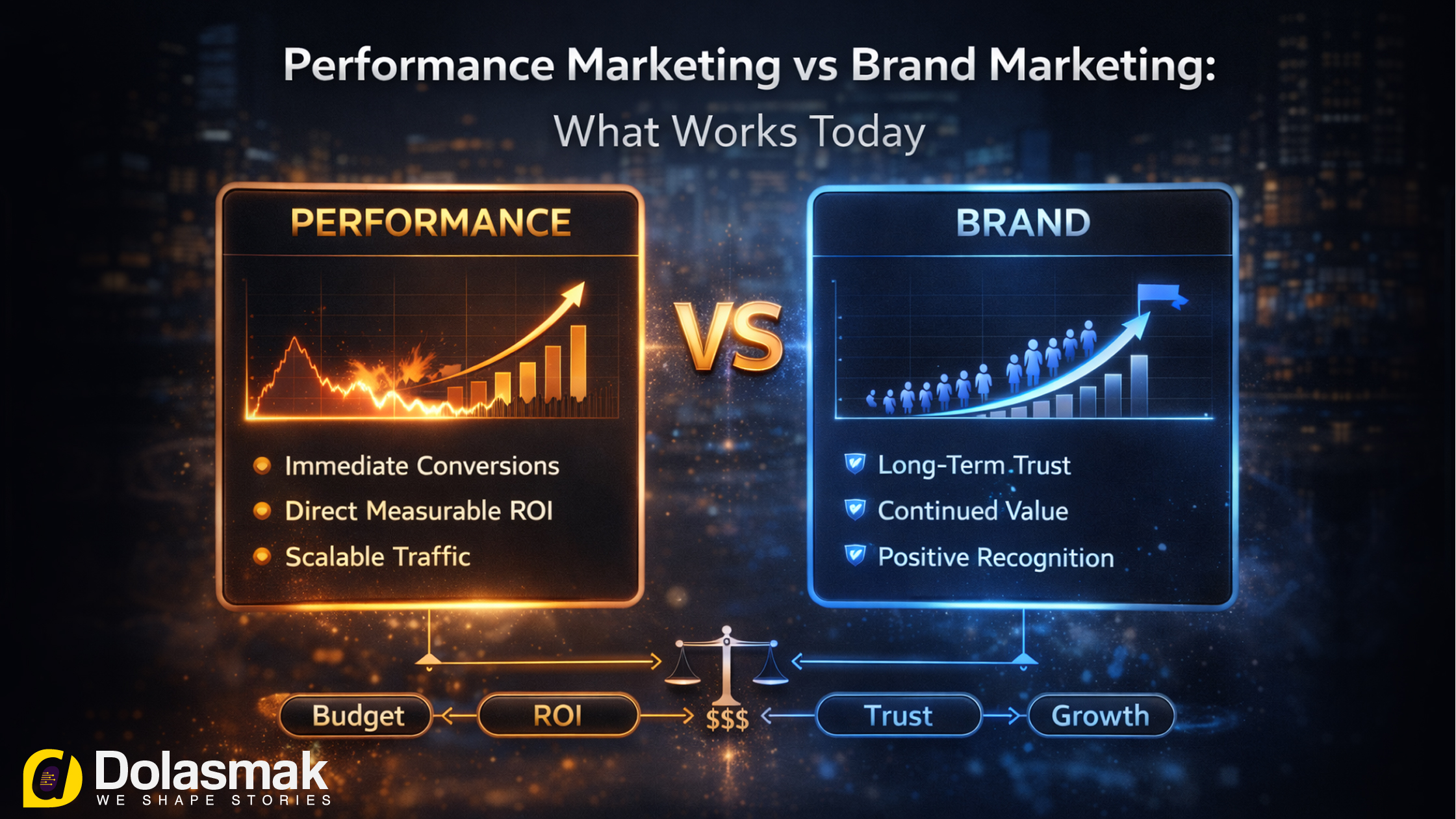
Performance marketing vs brand marketing is one of the most important debates in digital marketing today.
If you’ve ever sat with your team and asked, “Where should we spend our marketing budget?” — you’re not alone.
Some businesses chase quick wins through ads. Others invest in brand building and play the long game. The real confusion? Both approaches seem right… and both can fail when used blindly.
This is where the debate around performance marketing vs brand marketing becomes critical.
In today’s fast-moving digital landscape, choosing one over the other isn’t just risky — it’s often the reason growth stalls. Let’s break this down in a practical, no-fluff way so you can make smarter decisions for your business.
Understanding Performance Marketing Metrics: A Guide to performance marketing vs brand marketing
Performance marketing is exactly what it sounds like — marketing you can measure clearly.
You run ads, track actions, and pay for results. Whether it’s clicks, leads, or purchases, every rupee spent is tied to a specific outcome.
That’s why many businesses lean heavily into a performance marketing strategy, especially when they want quick ROI.
CPA, ROAS, CTR, and Conversion Tracking
If you’re running performance campaigns, these metrics matter more than anything else:
- CPA (Cost Per Acquisition)
How much you spend to get one customer. Lower CPA = better efficiency. - ROAS (Return on Ad Spend)
Revenue generated compared to ad spend. A ROAS of 4 means you earn 4x what you spend. - CTR (Click-Through Rate)
How many people click your ad after seeing it. This shows how attractive your message is. - Conversion Tracking
Tracks what users do after clicking — purchases, sign-ups, downloads.
These metrics make performance marketing highly attractive. You can scale what works and pause what doesn’t almost instantly.
Why Businesses Love Performance Marketing
- Fast results
- Clear data and reporting
- Easy to optimize campaigns
- Direct impact on revenue
But here’s the catch…
Performance marketing works best when people already know and trust your brand.
Without that, your ads become expensive, your CPA rises, and your conversions drop.
The Long-Term Value of Brand Marketing
Brand marketing doesn’t give you instant results. And that’s exactly why many businesses ignore it.
But that’s a mistake.
A strong brand marketing strategy builds something performance ads can’t: trust, recognition, and emotional connection.
Think about it — when someone sees your ad, they subconsciously ask:
“Do I know this brand?”
“Can I trust them?”
If the answer is no, even the best-performing ad struggles.
What Brand Marketing Actually Does
- Builds familiarity over time
- Reduces customer acquisition costs
- Increases conversion rates
- Creates long-term loyalty
Brand marketing includes:
- Content marketing
- Social media storytelling
- Video campaigns
- PR and awareness campaigns
It’s not about selling immediately. It’s about staying in the audience’s mind until they’re ready to buy.
Why It Matters More Today
In 2026, attention spans are shorter, and competition is higher.
People don’t just buy products anymore — they buy brands they recognize and relate to.
That’s why businesses investing in brand marketing often see:
- Better performance ad results
- Higher lifetime customer value
- Lower dependency on paid ads
Performance vs Brand Marketing: The Real Difference
Let’s simplify this:
| Performance Marketing | Brand Marketing |
| Short-term results | Long-term growth |
| Data-driven | Emotion-driven |
| Focus on conversions | Focus on perception |
| Immediate ROI | Delayed but sustainable ROI |
The mistake most businesses make?
They treat this as a choice.
It’s not.
How Smart Companies Combine Both Strategies
The smartest businesses don’t choose between performance and branding — they blend them strategically.
This is where a strong digital advertising strategy comes into play.
Step 1: Build Awareness First
Before pushing aggressive ads, create visibility:
- Educational content
- Social media presence
- Value-driven posts
This warms up your audience.
Step 2: Run Performance Campaigns
Now introduce:
- Lead generation ads
- Conversion-focused campaigns
- Retargeting ads
Because your audience already recognizes you, conversions become easier and cheaper.
Step 3: Reinforce the Brand
Even after conversions, continue brand-building:
- Customer stories
- Community engagement
- Consistent messaging
This increases retention and referrals.
Real-World Example (Simple Breakdown)
Let’s say you run an e-commerce store.
Scenario A: Only Performance Marketing
- You run ads → get clicks → low conversions
- CPA increases
- You keep spending more to maintain results
Scenario B: Brand + Performance
- You post helpful content → build awareness
- Run retargeting ads → higher conversions
- Lower CPA, better ROAS
Same product. Different strategy. Completely different outcome.
Which Marketing Strategy Gives Faster ROI?
If speed is your priority, performance marketing wins.
But if sustainability matters, brand marketing becomes essential.
The truth?
Performance marketing gives faster ROI. Brand marketing gives stronger ROI over time.
Businesses that rely only on performance often hit a plateau.
Those that invest in branding create momentum that compounds.
The Modern Approach to ROI Marketing Campaigns
Today’s winning strategy looks like this:
- 60–70% performance marketing (for revenue)
- 30–40% brand marketing (for growth stability)
This balance helps you:
- Generate leads consistently
- Build a recognizable brand
- Reduce long-term marketing costs
It’s not about spending more — it’s about spending smarter.
FAQs
What is performance marketing?
Performance marketing is a digital strategy where you pay for specific results like clicks, leads, or sales. It focuses on measurable outcomes and ROI-driven campaigns.
Is brand marketing better than performance marketing?
Neither is “better.” Brand marketing builds long-term trust, while performance marketing drives immediate results. The best strategy combines both.
How do companies balance branding and performance ads?
They create awareness first through branding, then use performance ads to convert that audience. This improves efficiency and lowers acquisition costs.
Final Thoughts: What Should You Do Next?
If your business is only running ads, you’re likely overspending.
If you’re only building a brand, you might be growing too slowly.
The real growth happens when both strategies work together.
At Dolasmak Digital, we help businesses design a balanced digital marketing strategy — one that drives results today and builds brand strength for tomorrow.
Whether you need a performance-focused campaign or a long-term brand roadmap, the right mix can completely change your growth curve.
Ready to stop guessing and start scaling?
Let Dolasmak Digital help you build a strategy that combines performance marketing and brand marketing the right way.
Reach out today and turn your marketing into a growth engine.